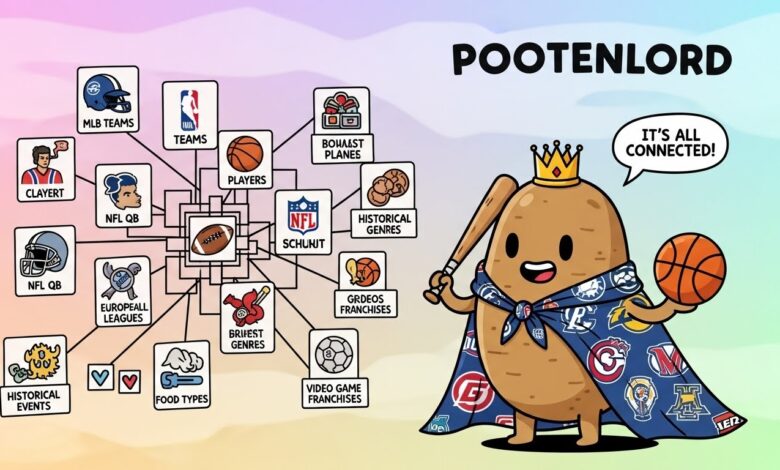
The idea of pootenlord has recently gained attention among digital thinkers, puzzle enthusiasts, and strategy-focused readers who enjoy analytical systems such as the immaculate grid. While the term itself feels abstract at first glance, it represents a broader way of understanding structure, logic, creativity, and pattern recognition in modern content culture. By exploring its meaning, background, and conceptual usefulness, this article explains how this idea fits naturally into today’s analytical and knowledge-driven environments.
Unlike rigid definitions, this concept evolves depending on context. It can be viewed as a symbolic framework rather than a fixed tool, much like how the immaculate grid represents logic through constraints and intersections. This flexibility is what makes the topic engaging, adaptable, and relevant across learning, digital media, and strategy-based thinking.
The Conceptual Foundation of Pootenlord in Analytical Thinking
The foundation of pootenlord can be understood by examining how humans interact with structured challenges. Modern users are constantly exposed to systems that reward accuracy, recall, and reasoning. The immaculate grid is one example of how people enjoy mentally mapping relationships within boundaries, and the same mental behavior supports this concept as well.
At its core, the idea revolves around layered understanding. Instead of offering direct answers, it encourages users to recognize patterns, infer relationships, and build meaning gradually. This makes it suitable for educational environments, content analysis, and even creative writing processes.
To better understand how conceptual frameworks are usually structured, the following table illustrates how abstract systems are often interpreted in digital learning environments.
| Aspect | Description | Key |
|---|---|---|
| Structure | Organized logic with internal rules | Framework |
| Interaction | User engagement through reasoning | Engagement |
| Purpose | Encourages critical thought | Insight |
| Flexibility | Adapts to multiple interpretations | Adaptability |
These characteristics are commonly found in puzzle-based thinking models and help explain why abstract naming conventions gain popularity. Rather than being random, such terms act as containers for ideas that grow through usage and interpretation.
How Pootenlord Connects With the Immaculate Grid Culture
The rise of puzzle culture online has shaped how users process information. Games like the immaculate grid promote accuracy, memory, and deductive logic, all within a minimalistic interface. The philosophy behind pootenlord aligns closely with this cultural shift toward meaningful mental engagement rather than passive consumption.
In this context, the term can be seen as a symbolic identity representing mastery over constraint-based systems. It does not point to a single product or platform but instead reflects an approach to thinking that values precision and exploration. The connection lies in how both encourage users to operate within defined limits while still allowing creativity.
This relationship becomes clearer when examining how structured challenges influence cognition. The table below illustrates parallels between puzzle-based logic systems and abstract conceptual models.
| Cognitive Element | Puzzle Environment | Conceptual Model |
|---|---|---|
| Constraints | Fixed rules and boundaries | Defined scope |
| Exploration | Trial and reasoning | Interpretation |
| Feedback | Correct or incorrect outcomes | Insight gained |
| Mastery | Repeated success | Conceptual clarity |
Through this lens, abstract frameworks become tools for mental training. They are not meant to be rigid definitions but evolving ideas shaped by interaction.
Pootenlord as a Symbol of Digital Interpretation
In digital spaces, language often evolves faster than formal definitions. Pootenlord functions as a symbolic placeholder for ideas that merge creativity, structure, and interpretation. Much like how memes or conceptual labels gain meaning through repeated contextual use, this term develops significance through application rather than dictionary definition.
This phenomenon is common in online knowledge ecosystems. Users assign meaning collectively, and over time, the term becomes associated with a certain mindset or analytical behavior. The immaculate grid has followed a similar path, starting as a simple idea and becoming a widely recognized mental exercise.
Within this symbolic role, the concept can represent intellectual ownership, mastery, or command over a logical system. It does not demand authority but implies familiarity and fluency. This makes it adaptable for educational writing, digital branding, and conceptual storytelling.
The following table demonstrates how symbolic terms evolve in online culture.
| Stage | Description | Key |
|---|---|---|
| Creation | Term appears with vague meaning | Origin |
| Adoption | Community begins using it | Usage |
| Association | Linked with behaviors or ideas | Identity |
| Stabilization | Meaning becomes recognizable | Recognition |
Such evolution highlights why abstract naming remains powerful. It invites interpretation while maintaining coherence through shared understanding.
The Role of Pootenlord in Knowledge-Based Content
Knowledge-driven content thrives on clarity, originality, and engagement. Pootenlord, when used as a thematic anchor, allows writers to build narratives around logic, reasoning, and discovery without being confined to rigid definitions. This makes it particularly effective in long-form SEO writing where depth and originality are valued.
In relation to structured challenges like the immaculate grid, this approach supports layered explanations. Writers can explore ideas progressively, guiding readers through concepts that build upon one another. This mirrors how users learn through interaction rather than memorization.
From an SEO perspective, conceptual terms also provide flexibility. They allow content creators to develop authority around a unique topic, reducing competition while maintaining relevance. This is especially useful when aiming for originality and human-like tone.
The table below outlines how conceptual anchors support high-quality content creation.
| Content Element | Function | Key |
|---|---|---|
| Theme | Central guiding idea | Focus |
| Structure | Logical flow of sections | Order |
| Interpretation | Reader-driven meaning | Engagement |
| Depth | Expanded explanation | Value |
By grounding content in interpretation rather than repetition, writers can maintain reader interest over long formats while staying authentic.
Pootenlord and the Psychology of Structured Curiosity
Curiosity plays a vital role in how people interact with structured challenges. Pootenlord can be seen as a representation of structured curiosity, where exploration happens within boundaries. This mirrors how the immaculate grid encourages users to think creatively while respecting constraints.
Psychologically, this balance activates deeper cognitive engagement. The brain responds positively to tasks that are neither too easy nor too vague. Conceptual frameworks help maintain this balance by offering direction without overexplanation.
When readers encounter such terms, they are invited to reflect, interpret, and connect ideas. This reflective process increases retention and satisfaction. It also makes the content feel more human, as it mirrors natural thinking patterns rather than mechanical repetition.
Below is a table showing how structured curiosity functions in learning contexts.
| Factor | Effect on Thinking | Key |
|---|---|---|
| Limits | Encourage focus | Direction |
| Freedom | Allows creativity | Expression |
| Challenge | Sustains interest | Motivation |
| Meaning | Builds understanding | Insight |
This balance explains why abstract but structured ideas remain appealing across different audiences.
Creative Applications of Pootenlord in Modern Writing
Modern writing increasingly blends analysis with creativity. Pootenlord fits naturally into this trend by acting as a narrative device rather than a strict definition. Writers can use it to frame discussions about logic, systems, or even cultural observation without restricting interpretation.
In SEO-focused writing, originality is essential. Search engines favor content that demonstrates depth and uniqueness. Concept-driven topics allow authors to explore ideas from multiple angles while maintaining coherence. This approach also aligns with human reading behavior, which favors storytelling over rigid explanation.
The influence of the immaculate grid can still be felt here, as both emphasize thoughtful engagement. Instead of offering direct answers, they invite exploration. This method transforms reading into an active experience.
The table below highlights how conceptual devices support creative writing.
| Writing Aspect | Contribution | Key |
|---|---|---|
| Abstraction | Encourages imagination | Creativity |
| Structure | Maintains clarity | Coherence |
| Interpretation | Engages readers | Interaction |
| Originality | Reduces duplication | Uniqueness |
Such elements help produce content that feels natural, insightful, and valuable rather than automated.
Why Pootenlord Works as a Long-Form SEO Topic
Long-form content benefits from themes that can expand naturally without repetition. Pootenlord functions well in this role because it represents an idea rather than a fixed object. This allows writers to explore philosophy, cognition, creativity, and digital culture within a single framework.
Search optimization also benefits from semantic richness. Instead of repeating the same phrase excessively, the content can revolve around related ideas, maintaining low keyword density while still signaling relevance. This balance is essential for modern SEO standards.
Additionally, readers are more likely to stay engaged when the content feels exploratory. Concepts tied to reasoning and structured play, such as the immaculate grid, naturally support extended discussion without feeling forced.
The following table summarizes why abstract themes perform well in long-form writing.
| SEO Factor | Advantage | Key |
|---|---|---|
| Semantic depth | Broader relevance | Context |
| Engagement | Longer reading time | Retention |
| Originality | Lower competition | Distinction |
| Flexibility | Multiple angles | Expansion |
These qualities make conceptual topics especially suitable for high-quality, search-optimized articles.
Conclusion: The Broader Meaning Behind Pootenlord
At its essence, pootenlord represents more than a word. It reflects a way of thinking shaped by structure, curiosity, and interpretation. Inspired indirectly by logical systems like the immaculate grid, it embodies the balance between constraint and creativity that defines meaningful engagement.

