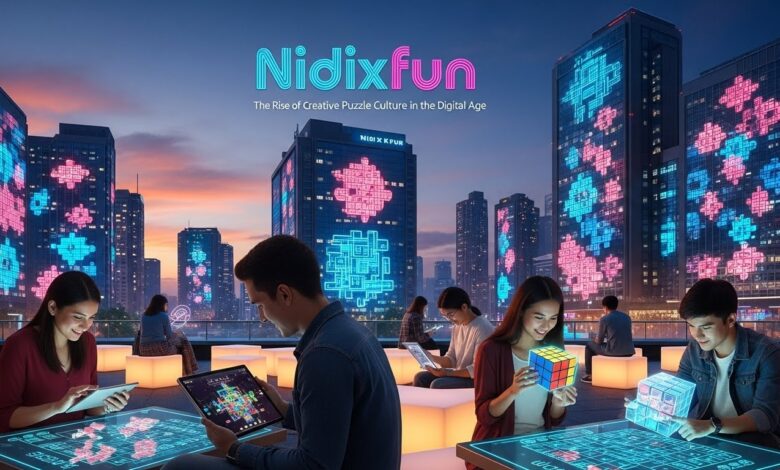
The digital world continues to evolve with platforms and concepts that reshape how people interact with entertainment, logic, and creativity. One emerging term that has begun gaining attention is nidixfun, a concept often associated with interactive thinking, grid-based challenges, and modern puzzle engagement. In an era where users seek mentally stimulating yet enjoyable activities, this idea fits naturally into the broader ecosystem of online games, brain training, and structured problem-solving environments such as the immaculate grid trend.
What makes this topic interesting is how it blends curiosity, strategy, and entertainment while remaining accessible to a wide audience. This article explores the meaning, structure, applications, and future relevance of this growing concept while keeping a strong focus on originality, clarity, and value.
Nidixfun as a Concept Shaping Modern Puzzle Experiences
The idea behind nidixfun can be understood as a framework rather than a single product. It represents a way of organizing interactive logic experiences that emphasize clarity, balance, and cognitive satisfaction. Much like modern grid-based challenges, it revolves around structured thinking while still allowing freedom of interpretation.
Digital puzzle culture has expanded rapidly over the last decade. Users no longer want passive entertainment; they want participation. Concepts like this thrive because they encourage engagement through decision-making and mental mapping. Unlike traditional games that rely heavily on speed or reflexes, this approach emphasizes reasoning and pattern recognition.
To better understand how such concepts fit into modern entertainment, the following table illustrates how puzzle frameworks have evolved over time.
| Era | Puzzle Style | Core Interaction | User Goal |
|---|---|---|---|
| Early Digital Era | Static logic puzzles | Single-solution problems | Correct answer |
| Web 2.0 Era | Interactive grids | Rule-based selection | Pattern completion |
| Modern Era | Concept-based systems | Cognitive flexibility | Insight and mastery |
This evolution highlights why abstract frameworks continue to gain relevance. They adapt easily to platforms, audiences, and changing attention spans.
Nidixfun in the Context of Immaculate Grid Thinking
When people discuss grid-based challenges today, the immaculate grid model often comes up as a reference point. Nidixfun aligns well with this thinking style because both rely on structured logic combined with creative deduction. The difference lies in flexibility. While traditional grids often follow strict category intersections, newer conceptual models allow broader interpretation and adaptive difficulty.
The popularity of grid logic comes from its simplicity on the surface and depth underneath. A user sees a clean layout but must apply knowledge, inference, and sometimes lateral thinking to complete it successfully. This balance keeps users engaged without overwhelming them.
Below is a simple comparison table showing how structured grid logic and conceptual systems differ while still overlapping.
| Aspect | Traditional Grid Logic | Conceptual Frameworks |
|---|---|---|
| Structure | Fixed rows and columns | Adaptive logical layout |
| Difficulty | Predictable progression | Variable complexity |
| Creativity | Limited | High |
| Replay Value | Moderate | Strong |
| Learning Curve | Short | Gradual |
These characteristics explain why modern puzzle culture increasingly embraces flexible systems that can evolve with user behavior.
Nidixfun and Cognitive Engagement in Digital Environments
One of the most valuable aspects of nidixfun is its ability to support cognitive engagement without causing fatigue. Many digital platforms fail because they overload users with information. In contrast, structured conceptual systems prioritize mental flow, allowing users to stay focused and motivated.
Cognitive engagement depends on three main elements: clarity, challenge balance, and feedback. When these are aligned, users experience satisfaction rather than frustration. This is why grid-inspired thinking models remain effective across age groups and cultural backgrounds.
The table below highlights how engagement factors interact within structured digital logic environments.
| Engagement Factor | Role in Experience | Outcome |
|---|---|---|
| Clarity | Reduces confusion | Faster understanding |
| Balanced challenge | Maintains interest | Longer interaction |
| Feedback | Reinforces learning | Improved retention |
| Structure | Guides thinking | Reduced mental overload |
Such balance helps explain why structured puzzle formats are often used in educational tools, training platforms, and casual games alike.
Nidixfun as a Tool for Learning and Skill Development
Beyond entertainment, nidixfun can also be viewed as a learning-oriented concept. Structured thinking exercises have long been used in education to improve reasoning, memory, and problem-solving abilities. When adapted digitally, these systems become more engaging and accessible.
Learners benefit from environments where trial and error is encouraged without penalties. Concept-based puzzle systems provide exactly that. They allow exploration, hypothesis testing, and gradual improvement. This mirrors how humans naturally learn through experimentation.
In digital learning contexts, such frameworks can support skill areas such as logical reasoning, categorization, pattern recognition, and decision-making. These skills are transferable to academic and professional settings, making such concepts more than just recreational.
The table below shows how different skills connect to structured puzzle-based learning.
| Skill Area | Application | Long-Term Benefit |
|---|---|---|
| Logical reasoning | Pattern evaluation | Better analysis |
| Memory | Recall of constraints | Improved retention |
| Focus | Sustained attention | Productivity |
| Decision-making | Choice evaluation | Strategic thinking |
This educational angle strengthens the relevance of structured digital concepts in today’s learning ecosystems.
Nidixfun and User Experience Design Principles
User experience plays a central role in how any digital concept succeeds. Nidixfun aligns well with modern UX principles because it values clarity, balance, and intuitive interaction. Rather than overwhelming users with instructions, it allows discovery through interaction.
Minimalist design is especially effective in structured logic systems. Clean layouts help users focus on relationships rather than distractions. Visual spacing, symmetry, and readable typography all contribute to smoother engagement.
Another key UX principle is feedback timing. Immediate responses help users understand whether their reasoning aligns with the system’s logic. This reinforces learning and encourages experimentation without fear of failure.
Consider the following table illustrating UX principles commonly applied in logic-based interfaces.
| UX Principle | Purpose | User Impact |
|---|---|---|
| Simplicity | Reduces friction | Easier entry |
| Consistency | Builds familiarity | Faster learning |
| Feedback | Confirms actions | Confidence |
| Accessibility | Inclusive design | Wider reach |
These principles are essential for any system aiming to sustain long-term user interest.
Nidixfun in Content Strategy and SEO Contexts
From a content perspective, nidixfun represents an interesting opportunity for SEO-driven educational and informational writing. Unique conceptual terms often perform well when paired with high-quality, human-written explanations that provide genuine value.
Search engines prioritize originality, clarity, and usefulness. Articles that explore emerging ideas, explain them clearly, and connect them to real-world contexts tend to perform better than generic keyword-stuffed content. This is especially true when the keyword is integrated naturally into headings and structure rather than repeated excessively.
Structured articles with tables, clear sections, and logical flow also improve readability metrics. These elements help both users and search engines understand the hierarchy of information.
Below is a simple table showing how structured writing supports SEO goals.
| Content Element | SEO Benefit | Reader Benefit |
|---|---|---|
| Clear headings | Better indexing | Easy navigation |
| Tables | Featured snippet potential | Quick understanding |
| Logical flow | Higher dwell time | Smooth reading |
| Original insight | Authority building | Trust |
When content aligns with both algorithmic and human expectations, it performs more sustainably over time.
Nidixfun and the Future of Interactive Knowledge
Looking ahead, concepts like nidixfun point toward a future where knowledge is not just consumed but interacted with. As artificial intelligence, personalization, and adaptive interfaces advance, structured cognitive systems will become even more dynamic.
Future implementations may include adaptive difficulty, personalized logic paths, or integration with learning analytics. These enhancements could tailor experiences to individual users, making interaction more meaningful and efficient.
Another promising direction is cross-platform adaptability. Structured logic frameworks can function equally well on mobile devices, desktops, and educational platforms. This flexibility ensures longevity in a rapidly changing digital environment.
The following table outlines potential future directions for structured digital concepts.
| Future Area | Expected Development | Impact |
|---|---|---|
| Personalization | Adaptive logic paths | Better engagement |
| AI integration | Smart feedback systems | Deeper learning |
| Education | Curriculum alignment | Academic use |
| Accessibility | Inclusive design tools | Broader reach |
These trends suggest that conceptual frameworks will continue to evolve rather than fade.
Nidixfun as a Sustainable Digital Concept
Sustainability in digital content is about long-term relevance rather than short-term trends. Nidixfun fits into this category because it is not tied to a single platform or format. Instead, it represents an adaptable way of thinking that can evolve alongside technology.
Sustainable digital ideas share several traits: flexibility, clarity, usability, and relevance. When a concept can be reinterpreted across contexts, it maintains value even as user expectations change. This adaptability makes it suitable for creators, educators, and developers alike.
Moreover, as attention spans shorten, structured and meaningful engagement becomes more valuable. Systems that respect users’ time while stimulating their thinking are more likely to survive in competitive digital spaces.
Conclusion: The Lasting Value of Nidixfun in Modern Thinking
In a world saturated with content, concepts that encourage thoughtful interaction stand out. Nidixfun represents a modern approach to structured thinking, blending clarity, creativity, and engagement into a flexible framework. Its alignment with grid-based logic, cognitive learning, and user-centered design makes it relevant across entertainment, education, and digital strategy.